
East African Businesses Missed SEO. Don’t Miss GEO
Summary
- East African SMEs missed the SEO wave a decade ago. Now, Generative Engine Optimization (GEO) offers a new start. GEO helps you get mentioned in AI tools like ChatGPT without a massive budget.
- Key changes: AI searches are reducing traditional web traffic by ~34%. But they create new “invisible” traffic from people who trust AI recommendations. To win, focus on clarity, authority, and structured content.
- This guide provides an 8-step plan for African businesses. It uses local examples and FAQs.
- Act now. Kenya leads global ChatGPT usage at 42.1%. AI is already shaping buyer decisions in the region. Adapt now to become the top mention in your niche.
Table of Contents
- What is Generative Engine Optimization (GEO)
- The Traffic Mystery That Changed Everything
- Why This Matters for East African Businesses
- The GEO Playbook for East African Businesses
- Local Business Examples
- GEO FAQs
- The Strategic Window: Why Now Matters
A decade ago, the internet gave East African businesses a new chance at visibility beyond physical storefronts. But most missed it. Search engine optimization (SEO)—the practice of making your website discoverable on Google—was dismissed as “too technical,” “too expensive,” or “only for big companies.”
What happened is that multinationals, tech-savvy startups, and agencies in Lagos or Cape Town dominated search results while Tanzanian, Kenyan, and Ugandan SMEs remained invisible. Customers searching online never found them. A lost decade of digital opportunity.
Now, another shift is unfolding and it is bigger than SEO. This time, the discovery layer isn’t just Google. It’s ChatGPT, Perplexity, Claude, Gemini, Copilot, and countless AI-powered assistants.
Instead of typing search terms into Google, people are asking AI for recommendations, insights, and lists. And those AI answers are influencing buying decisions.
This new discipline is called Generative Engine Optimization (GEO). It’s about making sure your brand gets mentioned inside AI-generated answers. Not through backlinks, not through keywords, but through clarity, authority, and presence.
For East African businesses, this is a second chance. If you missed SEO, you cannot afford to miss GEO.
Recent data makes the urgency hard to ignore. In July 2025, Kenya was the world’s top ChatGPT user. 42.1% of its internet users use the tool, and they are mostly young. South Africa ranked 8th globally.
This is the opportunity. Buyers in East Africa are already shaping their decisions inside AI tools. If your brand isn’t being mentioned in those answers, you’re absent where attention is allocated, and where trust is being made.
The Traffic Mystery That Changed Everything
Marketers worldwide began noticing a strange pattern in their analytics:
- Referral sources were drying up.
- Search impressions were down.
- But traffic still appeared—without any visible source.
No backlinks. No search terms. No referrers. Just… visits.
Dig deeper, and the explanation is simple: people are researching inside AI. They type prompts into ChatGPT or Perplexity for answers. And when a brand name is mentioned, they go directly to the website—leaving no trace of how they found it.
“ChatGPT mentioned you,” is the new word-of-mouth. Except the recommender is not a friend, it’s a machine.
That machine decides who gets named and who gets ignored.
Google’s AI Overviews (AIO) are exacerbating this. They already shave CTRs by ~34.5%, with users clicking away only about 8% of the time versus 15% without summaries, according to Ahrefs data. Zero-click searches for news surged from 56% to 69% in early 2025.
Why This Matters for East African Businesses
Let’s be honest: most businesses in our region never built serious SEO systems. Few invested in blogs, schema, link-building, or content libraries. Visibility relied on word of mouth, WhatsApp groups, or if lucky, Facebook Ads.
SEO felt out of reach. It required budgets, expertise, and patience that many SMEs lacked.
But GEO is different. Generative engines aren’t ranking websites the same way Google does. They’re synthesizing content, knowledge, and authority signals from across the web.
That means:
- If your expertise is clearly stated, AI can cite it.
- If your frameworks are branded, AI can reference them.
- If your business identity is consistent, AI can recognize it.
- If your content is scattered, shallow, or invisible, AI ignores you.
The opportunity here is that GEO has leveled the playing field. Big brands may have SEO dominance, but they don’t have a monopoly on clear, attributable knowledge. An SME that publishes sharp, structured insights can train the machine just as effectively.
In other words: if you move early, your business could leapfrog competitors who are still obsessing over old SEO playbooks.
What is Generative Engine Optimization (GEO)?
At its core, GEO is about being discoverable inside AI-generated answers.
Think of it as the next layer of search:
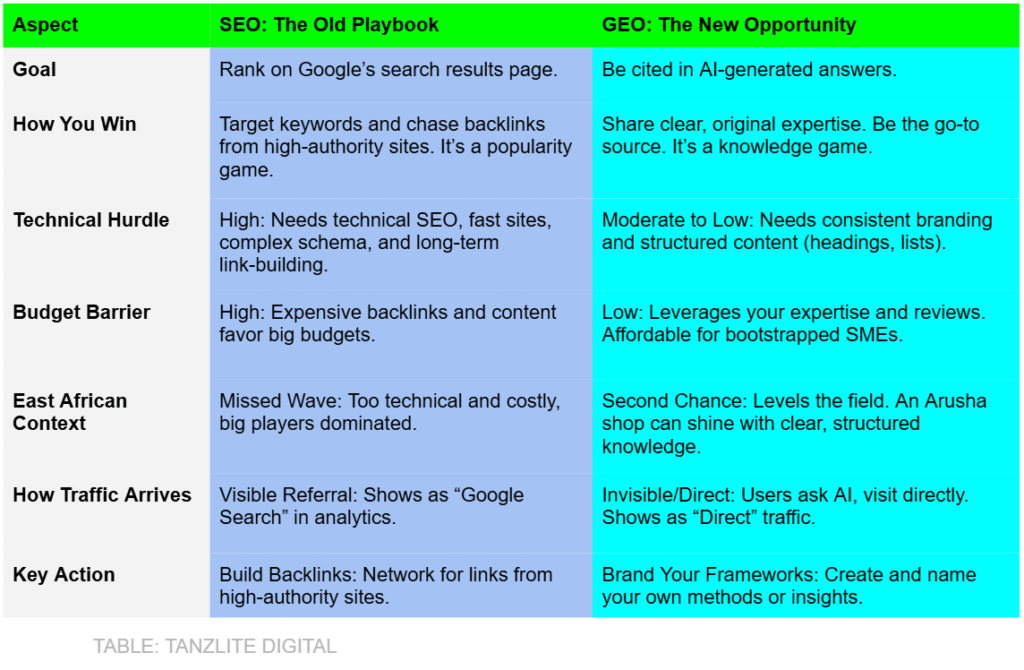
- SEO made you visible to Google.
- GEO makes you mentionable to ChatGPT, Perplexity, Claude, Gemini, and the next wave of AI tools.
Where SEO focused on keywords and backlinks, GEO focuses on clarity, structure, and identity. AI engines pull from many sources. They distill them into human-like responses, and decide whose name carries weight.
If your brand is not structured to be recognized, you’re invisible in this new layer of digital discovery.
The GEO Playbook for East African Businesses
So, how do you optimize for AI mentions? Here’s a practical playbook adapted for our context, blending local strategies with proven tips on getting cited in AI tools.
1. Use Your Full Business Identity Everywhere
AI tools reward clarity. If you’re inconsistent with your business name, tagline, or expertise, the system won’t attribute knowledge to you.
Write bios and descriptions like this:
“Tanzlite Digital is a boutique digital marketing agency in Tanzania that helps SMEs build direct-to-customer channels through strategy-led social media, websites, and messaging.”
Don’t rely on vague titles like “consultant” or “entrepreneur.” Spell out your niche and expertise in ways a machine can easily connect.
Pro Tip: Update your LinkedIn headline, company bios, press releases, and directory listings with the same consistent phrasing. You’re training the AI.
2. Structure Content Like a Source, Not a Status Update
AI loves digestible, extractable knowledge. If your content is buried in long rants, memes, or generic captions, it gets ignored.
Instead, write explainers and frameworks that can be lifted into AI answers. Examples:
- “3 signs your agribusiness is losing money on logistics”
- “The 5 steps we used to double our online coaching revenue”
- “Why Tanzanian SMEs fail at Facebook Ads (and how to fix it)”
Not all your content should be written for AI. Keep most of it human, narrative, and relationship-driven. But dedicate at least 30% of your publishing to “extractable” patterns.
Pro Tip: Use H2/H3 headings phrased as natural questions (e.g., “What are the benefits of mobile money for Kenyan SMEs?”). Followed by bullet lists and short summaries. This makes your content AI-friendly without losing human appeal.
3. Name Your Frameworks and Processes
AI engines cite what they can identify. If your methodology is nameless, it gets blended into the noise. If it has a name, it stands out.
Examples:
- “The Kariakoo Playbook for Retail Growth”
- “The Kilimanjaro Scaling Framework”
- “The Tanzlite Homepage Audit”
Once your framework is published consistently, the likelihood of AI referencing it multiplies. Even better: if competitors or journalists mention your framework, it reinforces attribution.
4. Spread Across Multiple Touchpoints
Don’t rely only on your website. AI engines learn from the whole internet: blogs, directories, social media, guest articles, podcasts, even press releases.
- Contribute to local industry blogs.
- List your business in Tanzanian or Kenyan online directories.
- Send AI-friendly press releases about milestones.
- Repurpose insights into LinkedIn and Medium posts.
The wider your digital footprint, the stronger your authority signal.
5. Leverage Reviews for GEO Boost
Reviews are a key component for AI citations. They provide fresh, real-user keywords, build E-E-A-T (Experience, Expertise, Authoritativeness, Trustworthiness), and signal an active business. Sites with steady reviews outperform static ones, turning 100 daily sales into 100 review opportunities.
Collect verified reviews post-purchase on platforms like Google Business Profile, Yelp, or Trustpilot. Reply to all for engagement—embed quotes on your site, like “AzamPesa saved my shop 20% on transactions.”
For East African SMEs, where trust is word-of-mouth driven, third-party reviews add credibility.
Pro Tip: Use schema markup for reviews to help Google interpret them, boosting visibility in AI Overviews.
6. Publish High-Value, Original Content
AI values credibility. Shallow copy-paste posts don’t count. What stands out is original research, local insights, or unique stories.
Examples for our region:
- A study of mobile money adoption in Dar es Salaam SMEs.
- Insights from 200 Nairobi entrepreneurs on digital marketing costs.
- Lessons from scaling an agritech in Arusha.
Originality = visibility. Machines prefer to cite the source, not the derivative. Make sure you back claims with data and sources to enhance E-E-A-T, share first-hand experiences like “After testing 50 campaigns…”.
7. Balance Machine-Readability with Human Resonance (Including Visuals)
Never forget: AI might mention your brand, but humans make the purchase.
Blend clarity with emotion. Publish testimonials, customer stories, and real narratives alongside structured frameworks. When someone clicks through from an AI mention, they need to feel your credibility instantly.
Incorporate visuals and videos for multimodal appeal. Embed YouTube Shorts (e.g., “3 Reasons to Switch to Mobile Money in Kenya”) or infographics on processes. Gen Z in East Africa (40% of searches on TikTok/YouTube) prefers this—AI like Gemini pulls visuals into overviews. Add alt text for accessibility.
8. Monitor, Refine, Repeat
This is still the Wild West. AI platforms evolve fast, and the signals aren’t always transparent. Track what works.
- Use GA4 filters to spot unusual traffic spikes.
- Ask new clients: “How did you find us?” Listen for “I saw you on ChatGPT.”
- Adjust content based on what resonates and gets repeated.
Over time, you’ll see patterns in what types of content actually get mentioned. Double down on those.
Local Business Examples (Brief)
Exporting Honey
Take a Tanzanian honey business that produces halal-certified honey for the Gulf. With SEO, they want their website to show up when someone Googles ‘Tanzanian honey exporter.’ But with AI GEO, they want to be the name that shows up when someone asks ChatGPT or Gemini: ‘Which African company exports halal honey to Dubai?’ If the AI mentions them, they’ve already won the trust of a potential bulk buyer before a sales call even happens.
TWiMMI
A Tanzania non-profit uplifting women in mining. It could increase its chances of being cited in AI by publishing structured case studies and naming its programs. Instead of generic captions, it could release “TWiMMI Pamoja Initiative Findings: The State of Women in Kahama ASM”. Something AI can reference when people women in mining in Tanzania.
GEO FAQs for East African Businesses
What’s the difference between SEO and GEO?
SEO ranks your site on Google; GEO gets you mentioned in AI summaries like ChatGPT or AI Overviews. GEO focuses on branded frameworks and reviews over technical backlinks.
How can I add schema markup to my site for better AI visibility?
Use free tools like Google’s Structured Data Markup Helper for FAQs and reviews. For a Tanzanian shop, mark up product pages with questions like “Do Maasai leather slippers last?” to match voice searches.
Why are reviews so important for GEO?
Reviews add fresh, user-generated content that boosts E-E-A-T. AI favors active businesses.
How do visuals help businesses in AI search?
AI tools are multimodal. Videos like Shorts on “Scaling Agritech in Arusha” get pulled into responses. They appeal to mobile-first users, which is the majority of East Africans.
The Strategic Window: Why Now Matter
Generative AI is still early. Most East African businesses have no idea this exists.
That’s both the danger and the opportunity.
- Danger: If you ignore it, bigger players will dominate the AI layer just like they dominated SEO.
- Opportunity: If you start now, you can become the default answer in your niche before competitors wake up.
This time, it’s not about expensive backlinks or huge ad budgets. It’s about clarity, consistency, and publishing content that machines and humans can both understand.
If you missed SEO, this is your reset button. Don’t miss GEO.
Thank You for Reading
At Tanzlite Digital, we’ve been helping East African SMEs build direct-to-customer channels through content and strategy. Now, we’re preparing our clients for the GEO era—making sure they don’t vanish from the AI-driven discovery layer.
If you want your business to be among the first names AI recommends in your category, start auditing your digital presence today. Structure your expertise, brand your frameworks, publish original insights, expand your footprint, and leverage reviews.
The machines are already answering. The only question is: will they mention you?