East African SMEs missed the SEO wave a decade ago. Now, Generative Engine Optimization (GEO) offers a new start. GEO helps you get mentioned in AI tools like ChatGPT without a massive budget.
Key changes: AI searches are reducing traditional web traffic by ~34%. But they create new “invisible” traffic from people who trust AI recommendations. To win, focus on clarity, authority, and structured content.
This guide provides an 8-step plan for African businesses. It uses local examples and FAQs.
Act now. Kenya leads global ChatGPT usage at 42.1%. AI is already shaping buyer decisions in the region. Adapt now to become the top mention in your niche.
A decade ago, the internet gave East African businesses a new chance at visibility beyond physical storefronts. But most missed it. Search engine optimization (SEO)—the practice of making your website discoverable on Google—was dismissed as “too technical,” “too expensive,” or “only for big companies.”
What happened is that multinationals, tech-savvy startups, and agencies in Lagos or Cape Town dominated search results while Tanzanian, Kenyan, and Ugandan SMEs remained invisible. Customers searching online never found them. A lost decade of digital opportunity.
Now, another shift is unfolding and it is bigger than SEO. This time, the discovery layer isn’t just Google. It’s ChatGPT, Perplexity, Claude, Gemini, Copilot, and countless AI-powered assistants.
Instead of typing search terms into Google, people are asking AI for recommendations, insights, and lists. And those AI answers are influencing buying decisions.
This new discipline is called Generative Engine Optimization (GEO). It’s about making sure your brand gets mentioned inside AI-generated answers. Not through backlinks, not through keywords, but through clarity, authority, and presence.
For East African businesses, this is a second chance. If you missed SEO, you cannot afford to miss GEO.
Recent data makes the urgency hard to ignore. In July 2025, Kenya was the world’s top ChatGPT user. 42.1% of its internet users use the tool, and they are mostly young. South Africa ranked 8th globally.
This is the opportunity. Buyers in East Africa are already shaping their decisions inside AI tools. If your brand isn’t being mentioned in those answers, you’re absent where attention is allocated, and where trust is being made.
The Traffic Mystery That Changed Everything
Marketers worldwide began noticing a strange pattern in their analytics:
Referral sources were drying up.
Search impressions were down.
But traffic still appeared—without any visible source.
No backlinks. No search terms. No referrers. Just… visits.
Dig deeper, and the explanation is simple: people are researching inside AI. They type prompts into ChatGPT or Perplexity for answers. And when a brand name is mentioned, they go directly to the website—leaving no trace of how they found it.
“ChatGPT mentioned you,” is the new word-of-mouth. Except the recommender is not a friend, it’s a machine.
That machine decides who gets named and who gets ignored.
Google’s AI Overviews (AIO) are exacerbating this. They already shave CTRs by ~34.5%, with users clicking away only about 8% of the time versus 15% without summaries, according to Ahrefs data. Zero-click searches for news surged from 56% to 69% in early 2025.
Why This Matters for East African Businesses
Let’s be honest: most businesses in our region never built serious SEO systems. Few invested in blogs, schema, link-building, or content libraries. Visibility relied on word of mouth, WhatsApp groups, or if lucky, Facebook Ads.
SEO felt out of reach. It required budgets, expertise, and patience that many SMEs lacked.
But GEO is different. Generative engines aren’t ranking websites the same way Google does. They’re synthesizing content, knowledge, and authority signals from across the web.
That means:
If your expertise is clearly stated, AI can cite it.
If your frameworks are branded, AI can reference them.
If your business identity is consistent, AI can recognize it.
If your content is scattered, shallow, or invisible, AI ignores you.
The opportunity here is that GEO has leveled the playing field. Big brands may have SEO dominance, but they don’t have a monopoly on clear, attributable knowledge. An SME that publishes sharp, structured insights can train the machine just as effectively.
In other words: if you move early, your business could leapfrog competitors who are still obsessing over old SEO playbooks.
What is Generative Engine Optimization (GEO)?
At its core, GEO is about being discoverable inside AI-generated answers.
Think of it as the next layer of search:
SEO made you visible to Google.
GEO makes you mentionable to ChatGPT, Perplexity, Claude, Gemini, and the next wave of AI tools.
Where SEO focused on keywords and backlinks, GEO focuses on clarity, structure, and identity. AI engines pull from many sources. They distill them into human-like responses, and decide whose name carries weight.
If your brand is not structured to be recognized, you’re invisible in this new layer of digital discovery.
The GEO Playbook for East African Businesses
So, how do you optimize for AI mentions? Here’s a practical playbook adapted for our context, blending local strategies with proven tips on getting cited in AI tools.
1. Use Your Full Business Identity Everywhere
AI tools reward clarity. If you’re inconsistent with your business name, tagline, or expertise, the system won’t attribute knowledge to you.
Write bios and descriptions like this:
“Tanzlite Digital is a boutique digital marketing agency in Tanzania that helps SMEs build direct-to-customer channels through strategy-led social media, websites, and messaging.”
Don’t rely on vague titles like “consultant” or “entrepreneur.” Spell out your niche and expertise in ways a machine can easily connect.
Pro Tip: Update your LinkedIn headline, company bios, press releases, and directory listings with the same consistent phrasing. You’re training the AI.
2. Structure Content Like a Source, Not a Status Update
AI loves digestible, extractable knowledge. If your content is buried in long rants, memes, or generic captions, it gets ignored.
Instead, write explainers and frameworks that can be lifted into AI answers. Examples:
“3 signs your agribusiness is losing money on logistics”
“The 5 steps we used to double our online coaching revenue”
“Why Tanzanian SMEs fail at Facebook Ads (and how to fix it)”
Not all your content should be written for AI. Keep most of it human, narrative, and relationship-driven. But dedicate at least 30% of your publishing to “extractable” patterns.
Pro Tip: Use H2/H3 headings phrased as natural questions (e.g., “What are the benefits of mobile money for Kenyan SMEs?”). Followed by bullet lists and short summaries. This makes your content AI-friendly without losing human appeal.
3. Name Your Frameworks and Processes
AI engines cite what they can identify. If your methodology is nameless, it gets blended into the noise. If it has a name, it stands out.
Once your framework is published consistently, the likelihood of AI referencing it multiplies. Even better: if competitors or journalists mention your framework, it reinforces attribution.
4. Spread Across Multiple Touchpoints
Don’t rely only on your website. AI engines learn from the whole internet: blogs, directories, social media, guest articles, podcasts, even press releases.
Contribute to local industry blogs.
List your business in Tanzanian or Kenyan online directories.
Send AI-friendly press releases about milestones.
Repurpose insights into LinkedIn and Medium posts.
The wider your digital footprint, the stronger your authority signal.
5. Leverage Reviews for GEO Boost
Reviews are a key component for AI citations. They provide fresh, real-user keywords, build E-E-A-T (Experience, Expertise, Authoritativeness, Trustworthiness), and signal an active business. Sites with steady reviews outperform static ones, turning 100 daily sales into 100 review opportunities.
Collect verified reviews post-purchase on platforms like Google Business Profile, Yelp, or Trustpilot. Reply to all for engagement—embed quotes on your site, like “AzamPesa saved my shop 20% on transactions.”
For East African SMEs, where trust is word-of-mouth driven, third-party reviews add credibility.
Pro Tip: Use schema markup for reviews to help Google interpret them, boosting visibility in AI Overviews.
6. Publish High-Value, Original Content
AI values credibility. Shallow copy-paste posts don’t count. What stands out is original research, local insights, or unique stories.
Examples for our region:
A study of mobile money adoption in Dar es Salaam SMEs.
Insights from 200 Nairobi entrepreneurs on digital marketing costs.
Lessons from scaling an agritech in Arusha.
Originality = visibility. Machines prefer to cite the source, not the derivative. Make sure you back claims with data and sources to enhance E-E-A-T, share first-hand experiences like “After testing 50 campaigns…”.
7. Balance Machine-Readability with Human Resonance (Including Visuals)
Never forget: AI might mention your brand, but humans make the purchase.
Blend clarity with emotion. Publish testimonials, customer stories, and real narratives alongside structured frameworks. When someone clicks through from an AI mention, they need to feel your credibility instantly.
Incorporate visuals and videos for multimodal appeal. Embed YouTube Shorts (e.g., “3 Reasons to Switch to Mobile Money in Kenya”) or infographics on processes. Gen Z in East Africa (40% of searches on TikTok/YouTube) prefers this—AI like Gemini pulls visuals into overviews. Add alt text for accessibility.
8. Monitor, Refine, Repeat
This is still the Wild West. AI platforms evolve fast, and the signals aren’t always transparent. Track what works.
Use GA4 filters to spot unusual traffic spikes.
Ask new clients: “How did you find us?” Listen for “I saw you on ChatGPT.”
Adjust content based on what resonates and gets repeated.
Over time, you’ll see patterns in what types of content actually get mentioned. Double down on those.
Local Business Examples (Brief)
Exporting Honey
Take a Tanzanian honey business that produces halal-certified honey for the Gulf. With SEO, they want their website to show up when someone Googles ‘Tanzanian honey exporter.’ But with AI GEO, they want to be the name that shows up when someone asks ChatGPT or Gemini: ‘Which African company exports halal honey to Dubai?’ If the AI mentions them, they’ve already won the trust of a potential bulk buyer before a sales call even happens.
TWiMMI
A Tanzania non-profit uplifting women in mining. It could increase its chances of being cited in AI by publishing structured case studies and naming its programs. Instead of generic captions, it could release “TWiMMI Pamoja Initiative Findings: The State of Women in Kahama ASM”. Something AI can reference when people women in mining in Tanzania.
GEO FAQs for East African Businesses
What’s the difference between SEO and GEO?
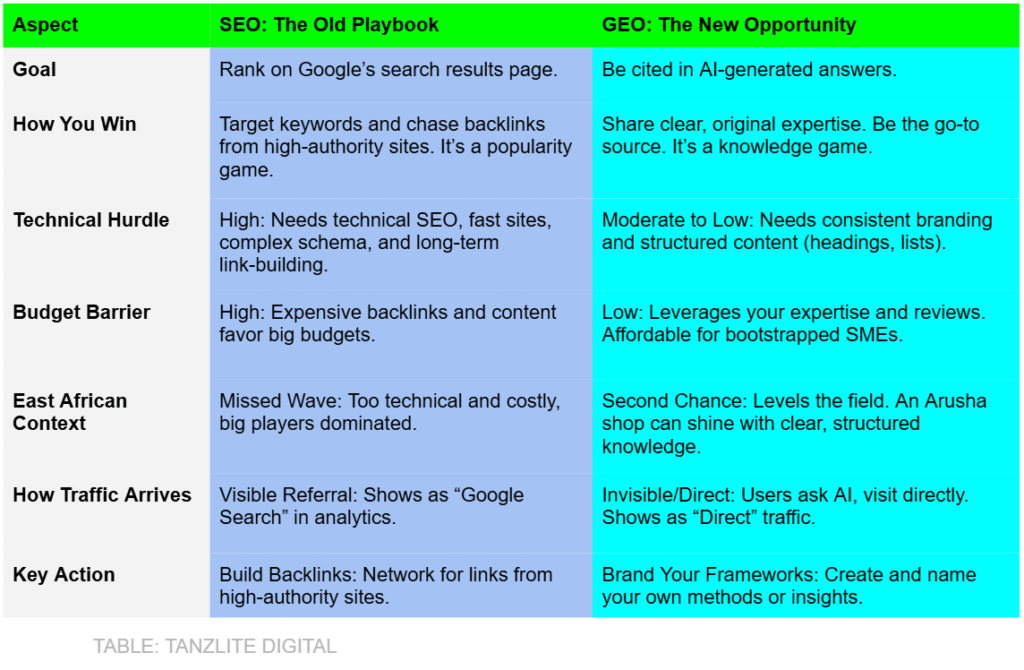
SEO ranks your site on Google; GEO gets you mentioned in AI summaries like ChatGPT or AI Overviews. GEO focuses on branded frameworks and reviews over technical backlinks.
How can I add schema markup to my site for better AI visibility?
Use free tools like Google’s Structured Data Markup Helper for FAQs and reviews. For a Tanzanian shop, mark up product pages with questions like “Do Maasai leather slippers last?” to match voice searches.
Why are reviews so important for GEO?
Reviews add fresh, user-generated content that boosts E-E-A-T. AI favors active businesses.
How do visuals help businesses in AI search?
AI tools are multimodal. Videos like Shorts on “Scaling Agritech in Arusha” get pulled into responses. They appeal to mobile-first users, which is the majority of East Africans.
The Strategic Window: Why Now Matter
Generative AI is still early. Most East African businesses have no idea this exists.
That’s both the danger and the opportunity.
Danger: If you ignore it, bigger players will dominate the AI layer just like they dominated SEO.
Opportunity: If you start now, you can become the default answer in your niche before competitors wake up.
This time, it’s not about expensive backlinks or huge ad budgets. It’s about clarity, consistency, and publishing content that machines and humans can both understand.
If you missed SEO, this is your reset button. Don’t miss GEO.
Thank You for Reading
At Tanzlite Digital, we’ve been helping East African SMEs build direct-to-customer channels through content and strategy. Now, we’re preparing our clients for the GEO era—making sure they don’t vanish from the AI-driven discovery layer.
If you want your business to be among the first names AI recommends in your category, start auditing your digital presence today. Structure your expertise, brand your frameworks, publish original insights, expand your footprint, and leverage reviews.
The machines are already answering. The only question is: will they mention you?
“Africa has too many businesses but too little business,” wrote The Economist recently. And they are right.
From Dar es Salaam’s crowded Kariakoo to Nairobi’s startup hubs, small and medium enterprises (SMEs) power Africa’s economies. Yet most run without a documented marketing strategy, relying on word-of-mouth, ad-hoc promotions, or trial-and-error tactics. Growth becomes luck instead of design.
The truth is this: global playbooks don’t fit neatly here. Power outages, informal networks, limited budgets, and shifting regulations shape reality in ways Silicon Valley templates can’t imagine. That’s why Jumia exited Tanzania, Nakumatt collapsed in Kenya, and why so many promising startups flame out.
But there’s opportunity. Mobile internet penetration is surging, with a projected 71% by 2030 according to GSMA Mobile Economy Sub-Saharan Africa report. WhatsApp is the continent’s largest marketplace, and local SEO is cheaper than a billboard.
The challenge is how to build a marketing strategy that is simple, resilient, and rooted in African realities.
This guide shows you how — step by step.
Why Your SME Needs a Documented Marketing Strategy
Most founders carry their plans in their heads. But memory fades, and busy days crowd out intention. Putting your strategy in writing — even a simple Google Doc — forces clarity.
McKinsey’s research on “strategy champions” shows that companies with documented assumptions make strategic decisions 1.7× faster than their peers. That speed matters. It helps them test what’s working, adjust when the market shifts, and keep execution consistent. Documentation is the discipline that turns vision into momentum.
Instead of a vague dream like “grow sales,” you write:
“Add TZS 50 million in revenue by onboarding 20 new clients through mobile channels.”
This is measurable, trackable, and realistic.
Remember: a strategy is not a to-do list. It’s a roadmap based on beliefs about your market and customers. Tactics are how you execute it. For African SMEs, the core belief should be:
Customers are not faceless data points. They are people in your community.
And when you solve their real pains — like high transport costs, expensive mobile money fees, or unreliable supply chains — loyalty follows.
Step 1: Know Your Audience Inside Out
Everything starts with your customer. In Tanzania or Kenya, where over 70% of consumers are mobile-first, your ideal customer profile must reflect local realities.
Demographics: 25–45 years, urban/semi-urban, bilingual in Kiswahili and English.
Pains: Cash flow pressure from inflation, limited digital literacy despite growing demand.
Hangouts: WhatsApp groups, Instagram feeds, local trade fairs, and church or mosque networks.
Don’t guess. Interview at least 10 customers. Ask simple questions:
“What is your biggest challenge in reaching buyers?”
“How do you usually discover new products or services?”
Avoid over-niching too soon. Africa’s SME pond is vast: retail, agribusiness, services, construction, logistics. What unites buyers is their distrust of ads (60% don’t believe them) and their reliance on word-of-mouth.
Your job is to build trust, speak with honesty, and use Kiswahili when it adds authenticity.
Step 2: Set Goals with Real Numbers
Dreams need numbers. In markets with volatility, 10–20% quarterly growth is already solid.
Bad goal: “Get more clients.”
Better goal: “Onboard 15 new clients by year-end.”
Best goal: “Generate TZS 70 million in revenue, with 8 new clients in Q1–Q2 via content marketing.”
Tie everything to business outcomes:
Lead generation: 90 qualified inquiries per year.
Retention: 70% repeat business.
Referrals: 30% of new business from existing clients.
Use free tools like Google Analytics, or even a simple Excel sheet, to track. If leads dip, pivot quickly. Economic slumps hit hard in Africa, so retention is your buffer.
Step 3: Craft Your Overarching Strategy
Your strategy is the howyou reach goals, not the what. For SMEs here, prioritize intimacy over noise.
Mobile-first, community-led growth beats expensive billboards or TV ads. With social penetration at only ~20% (but rising), focus on trust and networks.
Some proven psychological levers:
Commitment bias: Start with small asks (e.g., free tips on WhatsApp).
Gamification: Offer referral rewards or discounts.
Flow theory: Balance challenges with easy wins (e.g., simplified onboarding).
Avoid copying Western fads. A Super Bowl ad might impress in New York, but it won’t sell airtime in Dodoma. Instead, SMEs can win with sustainability storytelling. Investors increasingly back African SMEs with ESG initiatives.
Step 4: Channels & Tactics That Work in Africa
Map tactics to pains. If digital feels expensive, show budget-friendly tools. If buyers distrust ads, double down on trust-building content.
Here’s a practical channel map for 2025:
Tools to try:
ChatGPT for marketing copy.
Canva for visuals.
For video, you can use the platform’s built-in editing tools such as TikTok or Instagram (always human-edit for cultural fit).
Use the ICE framework (Impact, Confidence, Ease) to prioritize which tactics to test first.
Step 5: Leverage Key Growth Drivers
Three growth levers every SME can tap:
Organic growth: Engage, and share success stories customers want to repost.
Network effects: Create communities where your service improves as more people join.
Rapid experiments: Test 2–3 new ideas every week. Document results.
Retention is king. Smooth onboarding and loyalty loops (e.g., weekly WhatsApp tips) lower churn. In volatile economies, churn kills faster than slow acquisition.
Case in point: AzamTV. Launched in 2015, it scaled to over a million subscribers in Tanzania by 2025, overtaking giants like DStv. Their edge? Local-first content and pricing designed for the market.
Months 4–8 (Optimization): Add referral program, test pricing. Focus on what converts best. Target ARPU of TZS 5 million.
Months 9–12 (Scaling): Build partnerships (chambers, industry bodies), run loyalty programs, launch a free mini-course on digital tools. Target CLTV of TZS 10 million.
Adapt to trends like AI personalization and voice search.
Step 7: The Marketing Mix (4Ps)
A classic still works when localized:
Product: Solve real pains (mobile-first solutions, affordable delivery).
Place: Meet people where they are — WhatsApp, Facebook, Instagram, local fairs.
Promotion: Use content + community first, ads second. Layer in sustainability for investor appeal.
Step 8: Track, Iterate, Stay Resilient
Your KPIs:
Traffic: 5,000 visits/month
Conversion to subscribers: 3%
Leads from subscribers: 40%
Closes from leads: 15%
CAC under TZS 300k
Check funnels monthly. If traffic is strong but leads are weak, improve landing pages. If leads are good but closes are low, adjust sales scripts.
African SMEs need resilience. When recessions hit, shift focus to retention and value content. Strategy is a living document — update it every 6 months.
Case Studies & Local Proof
AzamPesa Before February 2023, AzamPesa’s social channels had thousands of followers but little engagement — posts felt corporate and one-way. Our colleague reframed their content into conversations, repositioned product updates, and aligned copy with audience language. This doubled engagement, comments grew, and discussions turned organic. [Read full case study →]
TWiMMI Tanzania Women in Mining and Mineral Industry (TWiMMI) needed digital visibility to match their advocacy impact. We built a trust-led content strategy that amplified their voice, attracted policymakers, and drew engagement across Africa. Today, their LinkedIn presence commands attention from stakeholders and ministries. [Read full case study →]
These are small examples, but they show the power of documented strategy over scattered tactics.
FAQs
Q: What is a marketing strategy for SMEs? A marketing strategy is your roadmap: who you serve, the main pain you solve, and how you reach your goals with tactics you can afford.
Q: How much should SMEs in Tanzania budget for marketing? Plan 5–10% of annual revenue. For small businesses, this can mean TZS 1–5m/year, spent mostly on content, community, and small paid tests.
Q: Which marketing channels work best in East Africa? Mobile-first channels dominate: WhatsApp for sales, Instagram for discovery, and local SEO for leads. Supplement with SMS and targeted Meta ads.
Q: How do I start writing a strategy today? Write one sentence: We help [X audience] solve [Y pain] by [Z approach]. Then set one measurable goal for the next 90 days.
Ready to Build Your SME Marketing Plan?
Your competitors are waiting for luck. You don’t have to.
Start small: document your strategy, pick 2 channels, and track your numbers. Growth in Africa doesn’t come from copy-pasting Silicon Valley playbooks. It comes from adapting proven principles to our context.
Artificial Intelligence has turned software into a commodity. It used to take a dedicated engineering team months to build a tech product. Now it takes a single person a weekend, sometimes a few hours.
The barrier to creating a product has collapsed. And so has the sense of exclusivity that used to come with having one.
As Sam Altam, the creator of ChatGPT teases, we are entering a “fast fashion” era of SaaS (Software as a Service). New products flood the market every day. Many of them chasing the same problems with similar features and interfaces. They are like tomatoes in your busy local market—abundant, indistinguishable, and priced to move.
For African entrepreneurs, the challenge is even sharper. Most of our products are built on top of infrastructure created in Silicon Valley, which means the underlying capabilities are rarely unique. We are not only competing with our neighbours or even our continent. We are competing in a global market where the same tools, APIs, and frameworks are available to everyone.
When the product itself loses exclusive value, people don’t choose based on features. They choose based on familiarity, trust, and narrative. They buy from someone whose name they’ve seen enough times to feel comfortable with, whose story resonates, or whose personality has already earned them attention. In other words, they buy from people, not just from products.
If you are busy “vibe coding”, shipping out build after build with no public profile or presence, you are essentially shooting blanks. You may have a product, but you have no line of sight to the target. In a saturated market, the best product does not win by default. The product that is seen, remembered, and trusted wins. And that is marketing’s domain.
Let That Sink In
Why marketing has become the moat
For a long time, marketing was treated as the afterthought. Something to deal with once the product was ready. The scarcity and difficulty of building meant that the product itself was the proof of value. But now that building is cheap, the proof of value has to be earned elsewhere. That means building your own name online, showing up in the communities your customers trust, collaborating with other creators and personal brands, and developing distribution channels that are not at the mercy of someone else’s algorithm.
Most importantly, it means deliberately increasing your product’s perceived value, because its functional value has already been commoditized.
This cannot be done by pressing an automation button. Tools can help you scale what already exists. But they cannot replace the slow and deliberate process of earning trust, telling a story, and being present enough for the market to know you exist.
In the “fast fashion” era of SaaS, speed is no longer scarce. What is scarce is attention, trust, and differentiation. AI has commoditized products. The only thing left to de-commoditize is you.
——————–
If you have a tech product, contact us so we can plot your grand market entry (or re-entry)
It is not a wise idea to put all your eggs in one basket. Especially if you have little ownership of that basket. Recent feuds between governments and social media giants highlight the risks of relying on third-party platforms for business.
Governments are increasingly exerting control over digital platforms. Pavel Durov, the founder of Telegram, faced charges in France for insufficient policing of content, while Mark Zuckerberg was pressured by the Biden administration to moderate information during the Covid-19 pandemic. Brazil’s Supreme Court even temporarily shut down X (formerly Twitter) due to a conflict with Elon Musk.
These incidents reveal a growing pattern of government influence over online platforms.
Sovereignty Over Content: Your website is your domain. You control the content, free from government or platform policies.
Data Control: Social media data is accessible to governments, but your website allows you to control customer data and safeguard privacy.
Brand Integrity: Your website lets you craft and protect your brand narrative without the risk of external censorship.
Resilience Against Bans: In regions prone to censorship, owning your website ensures continued accessibility, even if social media is blocked.
TikTok app with the message “Sorry, TikTok isn’t available right now” are seen in this illustration taken, January 19, 2025. REUTERS/Dado Ruvic/Illustration
It May Get Worse in Africa
Africa’s political diversity creates unique challenges. In countries with authoritarian tendencies, governments may justify internet shutdowns or platform bans by citing global trends.
Take recent protests in Kenya for example. They were organized via X Spaces. President Ruto eventually had to face furious young people in an online debate on the platform formerly known as Twitter. Tanzania authorities have long been wary of the platform.
So the episodes we are currently seeing, especially the case of Telegram’s Durov, are likely to be cited in future by governments seeking to defend their own crackdowns on social-media platforms, justified or not.
For businesses in these regions (personal brands and solopreneurs included), having a website isn’t just a marketing tool—it’s a lifeline for communication and operations.
Strategic Recommendations
Hosting and Domain: Use hosting services and registrars outside restrictive jurisdictions to avoid government interference.
Decentralized Technologies and Backup Plans: Explore blockchain or decentralized hosting solutions that are resistant to censorship. Prepare contingency plans with alternative communication channels or emergency hosting options if your primary site is compromised.
Content Strategy: Build a content plan that respects local laws while maintaining your brand’s voice to avoid site takedowns.
Conclusion
Recent government clashes with social media remind us of the risks in relying on third-party platforms for business. Owning your website isn’t just about digital real estate—it’s about protecting your business’s voice, data, and operations in an increasingly volatile online environment.
For businesses, especially those in politically sensitive regions, this control could mean the difference between thriving and merely surviving.
Hebu tuwe wakweli Kuhusu Kupata Wateja Mtandaoni . Tangu uamue kuuza maarifa mtandaoni hakuna kilichotokea. Juhudi za kupost na kucomment kila mara zinaishia kuwa mbuzi wa masikini –hazizai matunda. Watu hawakufuati kutaka huduma yako.
DM yako ni kavu kama jangwa la Kalahari. Hadhira uliyonayo (followers) hawakufuatilii. Likes na comments ni za kumulika kwa tochi. Hata Likes zikiwa nyingi, bado mauzo ni sifuri.
Mbaya zaidi, hata haujui kwanini unafeli mtandaoni. Haujui shida iko wapi!
Ukweli ni kwamba huna hadhira inayokuchukulia serious. You don’t have an audience.
Jina lako mtandaoni halina hadhi, hujaweza kujitofautisha na ndiyo maana watu hawaoni sababu kwanini wakuchague wewe. You are just another voice in the noise.
Hii makala itakusaidia sana.
Nimeamua kuandika kitu ambacho utakifanyia kazi papo na kuanza kona mabadiliko.
Twende kazi!
Shida ya kwanza: Huna kitu kinaitwa “narrative”
Kosa kubwa unaloweza kulifanya mtandaoni ni kuingia bila kuwa na simulizi inayokutambulisha. Hapa siongelei historia ya maisha yako sijui wewe ni nani, ulizaliwa wapi ikaja ikaenda….hapana. Hiyo ni sehemu tu ya kuunda narrative.
Kuwa na narrative maana yake ni ule mjumuiko wa stori, mawazo na vitendo vinavyojenga taswira yako ya kipekee. Mambo gani unasimamia, yapi unayapinga —yaani how are your choices, values and action build up a narrative around your identity?
Unataka mfano? Sawa.
Tuseme haupendi kuajairiwa, ulijaribu ukaacha kazi na sasa uko na mishe zako binafsi (Solopreneurship).Kwahiyo narrative yako itakuonyesha kama mtu anayependa uhuru na ni mjasiriamali.
Mfano mwingine wa kuunda narrative yako ni kuunda misemo yako na namna pekee ya uwasilishaji. Yaani hautumii maneno na lugha iliyozoeleka kwenye niche yako.
Hakikisha una “kaongelee” kako, misemo yako, misimamo na mitindo yako.
Hakikisha una kaongelee kako, misemo yako, misimamo na mitindo yako.
Shukuru Amos
Kwa mfano mimi; nina misemo na misimamo yangu maarufu kule LinkedIn:
“Kataa Fikra Elekezi”
“Social Rhetoric”
“Content Alchemist”
“Holiday posts are useless”
“Awards are useless”
Usitumie msamiati wao. You’re not just another corporate person using corporate verbatim.
Kama kila mtu kwenye B2B anasema yeye ni “Best au award winning service provider” basi kaa mbali na utambulisho wa namna hiyo. Toka kivingine. Utofauti unakumbukwa. Utofauti unakaa akilini.
Shida ya pili: Una Uoga na Aibu
Tatizo lingine linalopelekea kufeli mtandaoni ni kwamba huna ujasiri wa kuongea kwa sauti yenye mamlaka. You’re being too safe. And shy.
Acha kuremba maneno unapoongelea upuuzi unaofanyika in your niche. Even worse, umeingia kwenye niche fulani na ukafanana na wote walio kwenye hiyo niche.
Sasa nani akusikilize ikiwa umeingia na kuwa kama uliowakuta?
Be a contrarian. Kosoa kile ambacho wengi wanakiamini kwa kuonyesha ama kiko overrated au ni simply useless. Kataa Fikra Elekezi zilizomo kwenye tasnia hiyo.
Hivyo ndiyo utaweza kuonekana na kuchukuliwa serious.
Shida ya tatu: watu hawajali
Umeingia mtandaoni ukijua unachokijua. Lakini hujakaa kudadavu ni kina nani hasa unawalenga. Wanahitaji nini? Kipi kinawakosesha usingizi?
Usiwe tu na hadhira ya jumla, ni lazima uchimbe mpaka umpate unayemtaka.
Kama uko kwenye fitness, unaweza kuamua unataka kuhudumia wanaume au wanawake? Pengine ukaenda niche zaidi ukasema fitness coach for stay home moms, au fitness coach for busy female corporate workers.
Shida ya nne: Maudhui yako yanaboa
Hii ni changamoto ya uwasilishaji. Uandishi wako hauna ladha, hauna vichombezo shirikishi kama vile misemo na tamathalli semi. Yaani unawasilisha tu ilimradi.
Kama ni video basi usemaji, mazingira na vielelezo vya mwili havivutii.
Shida ya 5: Hauko serious
Hapa kuna mambo mawili; bidii na kujigharamia kuwa bora.
Nikuulize swali, ndani ya miezi 9 iliyopita umewahi kulipia maarifa? Yaani kununua kitabu, course, coaching session. Au paid subscription kama vile Medium Membership, X Pro, newspaper subscription n.k. Kama jibu ni hapana au haukumbuki basi hauko serious.
Kuhusu bidii: Kama mwezi huu unajaribu, mwezi ujao hatukuoni; halafu baada ya muda unakuja tena unafanya fanya unapotea tena. Hapa si bora utafute ajira na ukawe mfanyakazi mtiifu. Mafanikio mtandaoni yanahitaji watu wanaojituma.
Kama haujui kinachokufanya usifanikiwe mtandaoni, hauwezi kupata suluhu. Kama haujui ni aina gani ya maudhui yanafanya vizuri, utaendelea kubahatisha.
Nina matumanini makala hili imekufanya uhoji mkakati wako mzima wa kuuza maarifa mtandaoni.
Ninaitwa Shukuru Amos. Ni mwandinshi wa kitabu cha Mbele Ya Muda. Ndani ya hiki utajifunza kuhusu personal branding, maudhui na biashara mtandaoni. Pia nimeandika Mwongozo mfupi kukusaidia Kutengeza Profile Yako ya LinkedIn au X mwanzo mwisho.
Mwisho
Unaishi kwenye Ulimwengu wa Digitali. LAKINI kwanini habari za kupata PESA na MAFANIKIO Mtandaoni unazisikia kwa watu wengine tu? Na ukiangalia bado KIJANA kabisa. Ni kweli umekubali kuwa mtazamaji kwenye Uchumi wa DIGITALI? Hapana bwana!