When you visit McKinsey’s homepage, you’ll notice something new. Right beneath their hero banner sits an AI chatbot that speaks like a consultant. It’s fast, confident, and perfectly on-brand.
That small addition says a lot about where business is headed. AI isn’t just a back-office experiment anymore. It’s part of how modern companies deliver value, communicate, and operate.
And the best part is that you don’t need McKinsey’s budget to join this wave.
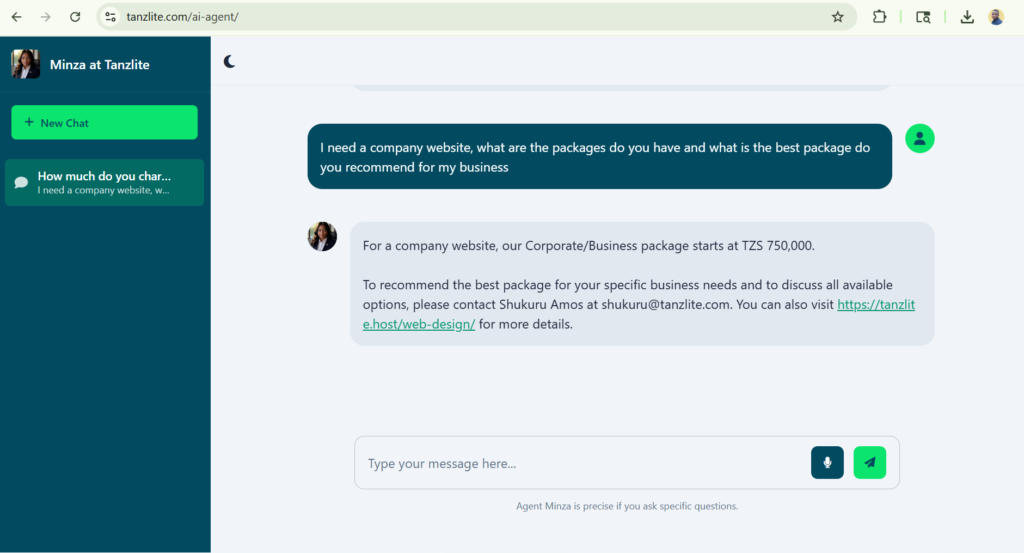
At Tanzlite Digital, we’re already helping African SMEs build and deploy their own AI Agents. The agent is tailored to their data, workflows, and market realities.
1. The Gap Between AI Hype and SME Reality
For most African businesses, AI still sounds like science fiction. After all, it is something built in San Francisco, not Dar es Salaam or Nairobi.
Yet the business pain points are the same everywhere:
Repetitive customer questions that eat into staff time.
Leads that slip through cracks because follow-ups aren’t automated.
Knowledge scattered across WhatsApp groups, emails, and PDFs.
AI Agents can now handle all that. They can answer customer queries, qualify leads, assist your team, and even generate reports — at a fraction of the cost of hiring.
The challenge here is not about technology. It is about translation: how to turn global AI potential into local business value?
That’s where Tanzlite comes in.
2. What Exactly Is an AI Agent?
Let’s forget the buzzwords for a second. An AI Agent is simply a digital employee trained to perform a specific role using your company’s data.
For example:
A Customer Support Agent that answers FAQs and escalates complex issues.
A Sales Assistant that qualifies leads through chat and updates your CRM.
An Internal Knowledge Agent that helps your staff find SOPs, policies, or product info instantly.
Think of it as an employee who:
Works 24/7, never complains.
Learns fast from your documents.
Costs less than your monthly Wi-Fi bill.
3. Why It Matters for African SMEs
Automation isn’t a luxury anymore. It’s survival.
In most African markets:
Staff turnover is high.
Response time determines whether you close a sale.
Customers expect digital consistency.
Yet most SMEs are still doing everything manually — replying to the same questions, re-sending the same forms, repeating the same onboarding process.
AI Agents solve this by freeing humans from repetitive tasks. Instead of spending hours answering inquiries, your team can focus on relationship-building and growth.
It’s not about replacing jobs. It’s about multiplying your capacity without multiplying your payroll.
4. Real-World Use Cases You Can Deploy Today
AI deployment doesn’t need to be all-or-nothing. You can start small, test value, and scale up.
Level 1: Single Workflow Automation
Ideal for businesses just starting with AI.
FAQ chatbots for your website or WhatsApp.
Lead capture agents that qualify prospects automatically.
Example: A logistics company using an AI bot to respond to delivery status queries 24/7, freeing their admin team.
Level 2: Multi-Workflow Integration
For SMEs ready to link multiple departments.
Customer support + CRM updates.
WhatsApp chat + email follow-ups.
AI-generated reports from customer interactions.
Example: A property firm that uses an AI agent to capture leads from social media, qualify them, and push data to their CRM.
Level 3: Full Automation Layer
For businesses aiming at scale.
AI handles support, data entry, lead qualification, and daily reporting.
Integrated with ERP or accounting tools.
Supervised by your team through dashboards.
Example: A service company running 80% of customer queries through AI, with only complex cases handled by humans.
5. What You Actually Need to Deploy
Here’s the good part — it’s not as complicated as people think.
Core Ingredients:
Chat Interface: where the agent lives (website, WhatsApp, Messenger).
Automation Layer: handles logic and integrations (n8n, Zapier, or custom).
AI Model: brains behind the agent (OpenAI, Claude, or Mistral APIs).
Knowledge Base: your internal data — PDFs, FAQs, product sheets, etc.
Combine those four, and you have a working AI employee.
At Tanzlite Digital, we use flexible tools so clients aren’t tied to a specific vendor. That means you pay directly for your API usage (usually under $30/month) while we handle the design, setup, and optimization.
6. The Cost Reality for African SMEs
Let’s address the elephant in the room: AI sounds expensive. It’s not — if done right.
Here’s what most clients discover:
Setup cost: between $200–$900 (depending on complexity).
Monthly maintenance:$70–$100 (optional but useful).
Third-party costs: API + automation tools, typically under $50/month.
That’s cheaper than hiring one full-time junior employee. And your AI Agent works every day, every hour. It does not get sick, need food or have a family.
The key is cost transparency: we don’t resell APIs. You pay OpenAI or n8n directly. We can even help you self host n8n at Hetzner and slash prices dramatically. Our focus is building and maintaining the system that runs your business better.
7. The Tanzlite Digital Approach
We designed our AI service tiers specifically for African SMEs. They’re simple, modular, and predictable.
Lite (Entry level)
For businesses testing one AI workflow (like an FAQ bot).
Our promise: No hidden tech fees. No vague “AI strategy decks.” Just working agents built for your business.
8. What Makes This Different
Most “AI” services online are still theoretical. They’re strategy slides, not real deployment.
Our approach is hands-on. We’ve already built Minza, our internal AI Agent at Tanzlite Digital, as a proof of concept. She can:
Understand client briefs.
Suggest content ideas.
Retrieve company documents instantly.
We built her not to impress investors, but to test reality: Can we build a fully functional AI agent using publicly available tools and local expertise?
The answer was yes.
Now, we’re taking that same process to African SMEs — one workflow at a time.
9. The Competitive Edge for Early Movers
Every major shift creates a gap between early adopters and late followers.
When websites became mainstream, the first companies online gained legitimacy.
When social media took over, the first brands to show up built massive reach organically.
Now, AI is that next shift.
The question isn’t “will AI change business?” It’s “who in your industry will master it first?”
Early adopters will operate leaner, faster, and smarter. And they’ll attract customers who expect that level of responsiveness.
10. Getting Started (Without Getting Lost)
If you’re reading this and thinking “We want to try this, but where do we even start?” — that’s the right question.
Here’s how we usually begin:
Scoping Session: identify where AI can create quick wins.
Prototype Build: deploy a working agent for one workflow.
Pilot Run: test with your team or customers.
Optimize + Scale: expand into more workflows based on data.
Each step gives you visible ROI before the next one begins.
11. Final Word
AI is no longer a distant future. It’s a practical tool your business can start using today.
You don’t need millions. You just need clarity, a focused use-case, and a partner who understands both technology and your business environment.
“Likes ain’t cash,” says JK Molina, a ghostwriter and brand growth strategist. We all know what he means. As a personal brand or a founder, your goal is beyond collecting likes. It’s to build a profitable audience.
This is especially important in Africa, where youth unemployment is chronic and salaried jobs are scarce. Building an audience that generates trust, leads, and income is a matter of economic liberation.
Take my journey, for example. LinkedIn helped me escape unemployment in Tanzania. From starting with a handful of connections to becoming the most followed Tanzanian marketer on LinkedIn, my personal brand has paid my bills, built my agency Tanzlite Digital, and created a life in the city of Dar es Salaam that would’ve been impossible otherwise.
In 2023, I published my Swahili book Mbele Ya Muda which sold 1.4m TZS in two weeks. About 500,000 TZS of that was in pre-order sales.
This article is a blueprint with practical, psychology-driven steps to grow an audience that makes you money.
First impressions online work the same as in real life. People size you up in seconds.
On LinkedIn, Twitter, or any platform, your profile is your storefront. If it’s vague or half-baked, you’ll lose before you start.
Key rules:
Photo: Use a clean, professional photo. Doesn’t need to be studio-quality, just clear and approachable. If you choose to go anonymous on Twitter/X, understand that it comes with an added difficulty to an already harder trust-building process.
Headline / Bio: Don’t write stuff like “Passionate in AI” or “Data Enthusiast.” Write who you help and how. Example: Helping Tanzanian SMEs turn social media attention into paying clients.
About section: The about section (on LinkedIn) is not about you. Focus on talking to the reader: their problem and how you solve it.
Links: Make it easy for people to find your work, whether that’s a WhatsApp link, portfolio, or shop.
Think of this as setting the table before inviting guests. If the table is messy, nobody eats.
I wrote a 34-page guide in Swahili (Tengeneza Profile Mwanzo Mwisho) on profile optimization. If you speak the language, you’ll benefit from step by step implementations with images and illustrations.
Part 2: Audience Building Is Networking
Most people don’t understand that building an audience is building a distribution network.
Forget “growth hacks.” Forget algorithm worship. Audience growth is the digital version of networking. The rules of human connection still apply. What has only changed is the medium.
And the first rule is simple: never show up empty-handed.
When you show up at a party offline, you bring wine, a story, a joke, a vibe. In the online space, your gift is attention.
Reach Across, Not Up
This is where beginners mess up. They chase the big names—commenting under influencers, tagging gurus, aiming for people way above their weight class. It’s like handing a billionaire one dollar. Or being a dude commenting “wow” to an Instagram hot girl.
Instead, start across.
If you have 30 followers, engage with people who have 20. If you have 100, talk to those with 50. These are the people who actually value your attention.
This may feel degrading at first. You’ll spend an hour commenting under small accounts that get 2 likes. You’ll think it’s pointless. But this is how you build your platoon—your first circle of allies.
Not friends. Not clients (yet). But peers with aligned goals.
A handful of these people consistently engaging with you creates perception. Online, perception is gravity. Once 5–10 people lean into your posts, others follow. Social proof is contagious.
That’s how you start looking like “someone.”
Part 3: Following and Getting Followers
Now, let’s get tactical.
At 0–500 followers: Be a reply guy. Show up in the comments. Don’t just say “Love this take.” Point out what resonated, add one sharp angle, or ask a question. Be specific. Be human. If you go to a big account, don’t comment on the post itself. Comment on a comment of someone within your follower range.
At 500–1,000 followers: Start publishing niche posts. Lean contrarian if you can—“hot takes” work when they challenge assumptions in your niche. Example: Most Tanzanian SMEs don’t need TikTok. They need consistent WhatsApp broadcasts.
Beyond 1,000: Build repeatable themes. Inject your signature ingredients your audience can recognise. Share frameworks, stories, and behind-the-scenes lessons.
A note on DMs: once you vibe with someone, move it to private chat. No pitching. Say something like “I’m growing, would love to stay in touch and support each other.” Be genuine, not clever.
Remember: most of your early circle will quit or you will outgrow them. That’s understandable in a long game like this. You have to keep moving.
The Composition of Your Audience
Who makes up your audience matters as much as how big it is. A healthy mix looks like this: half should be your ideal buyers, about 40% peers in your field, and the remaining 10% from complementary disciplines that sharpen your perspective. Too many peers (over 60%) and you end up with empty applause — “facts bro, nakubali kaka” — but no customers.
Still, don’t throw them out completely. Peers fuel the visible conversations that your real buyers often watch in silence. Their comments create social proof, making it easier for your ICP to trust you. The trick is balance. Enough peers to spark activity, but not so many that your feed turns into a vanity echo chamber.
Part 4. Content Strategy: What to Post
Most “personal brands” post blindly. They chase likes, retweets, and applause. But the brutal truth is that not all attention is equal. If your content doesn’t speak to the right layer of your audience’s psychology, you’ll end up entertaining people who will never buy.
Understanding Audience Psychology
Think about your audience through Maslow’s hierarchy of needs. It’s a pyramid.
Every single prospect you’ll ever meet is somewhere on this pyramid. If you’re creating content without this in mind, you’ll struggle to pay rent and uplift your living standard.
The uncomfortable truth you need to understand is that most of the internet lives at the bottom. They’re not here to buy. They’re here to escape. Their biggest problem isn’t “lack of leads” or “how to scale” — it’s boredom. That’s why entertainers dominate attention online. Khaby Lame, Kili Paul, Elsa Majimbo, MrBeast, — they sell traffic, not transformation.
If you play their game — optimizing for clicks, laughs, and shock value — you’ll build an audience of scrollers. They’ll smile, tap like, and vanish. No sales. No clients. Just vanity metrics.
If you want buyers, not just followers, your content has to climb the pyramid.
What Changes as You Climb
Safety tier: These people want stability. They’re looking for competence, reliability, and predictability. Content here is about demonstrating control — systems, processes, structures that reduce risk.
Belonging tier: These people buy identity. They want to feel seen, represented, and part of a movement. Content that signals “you’re one of us” creates long-term loyalty.
Esteem tier: Here, the game is status. These prospects want results that make them look sharper, more capable, more credible. If your content makes them feel like winners — respected by peers and competitors — they’ll pay premium rates.
Self-actualization tier: The smallest tier, but the highest value. These are mastery-driven buyers. They’re already successful, already stable, already respected. What they want now is leverage, legacy, and vision. They will pay top dollar. But only for guidance at the level of strategy, direction, and transformation.
You will notice that the higher you go, the smaller the audience, but the bigger the deal size.
Messaging for Each Tier
If you’re selling high-value expertise, ignore the very bottom. Escapist messaging (“quit your 9–5,” “fire your boss,” “easy money hacks”) gets you engagement — but from the wrong crowd. These followers don’t have buying power.
Instead, focus your messaging higher up the pyramid:
Safety: Show reliability. Demonstrate you know how to remove chaos and reduce risk. Share frameworks, processes, and case studies that prove stability.
Belonging: Reinforce identity. Signal that you’re speaking to a specific group, not everyone. Make them feel part of something bigger.
Esteem: Play to their fear of mediocrity. Position your content as the difference between looking average and looking like a pro. Share proof of results that elevate their status.
Self-actualization: Stop talking tactics — talk vision. These people don’t need more “how-to.” They want direction, insight, perspective. Show them what’s next.
Bottom line:
Bottom = empty promises and clicks
Middle = operations and tactics
Top = strategy and insight
Climb the pyramid, or stay stuck creating content for people who will never pay you.
Part 5: Monetizing Your Audience
Getting people to finally buy from you is the effortless result of a well-built audience and targeted content. It is not forced because it is the natural outcome of trust.
Some of the best ways to monetize your audience:
Ebooks and templates (low-cost, high-scale).
Cohorts or group programs.
One-on-one coaching or consulting.
Paid newsletters.
Sponsorships (once you have reach).
I would avoid selling online courses if I were you. Too many bad actors have given them a bad name. But packaged knowledge in ebooks or workshops still works beautifully.
The key principle here is to sell what you’ve already proven in public. If people engage with your tips on social media, package them. If you’ve been asked the same question 10 times in DMs, turn it into a product.
Now, understanding audience psychology is half the battle. You also need to diagnose the common mistakes solopreneurs make when trying to turn attention into income.
Five Reasons Your Followers Don’t Buy (and How to Fix Them)
You don’t need me to tell you that having followers is not the same as having clients. Many solopreneurs in Dar es Salaam, Nairobi, Kampala, or Kigali have thousands—even tens of thousands—of followers, but their M-Pesa, Airtel Money, or bank balance tells a different story. Why? Because they’re stuck accumulating followers or trying to go viral.
Here are the five biggest reasons your audience isn’t buying—and how to fix it:
1. You show likes, not proof of skill.
People don’t buy tweets or hot takes. They buy outcomes. A fitness coach who only posts selfies gets likes. A coach who posts client transformations gets clients. Same for agencies, consultants, and freelancers. Make sure you share your proof of work. Share before-and-after stories, case studies, and receipts that prove you solve real problems.
2. You act like a low-status account.
Online business is a status game. People follow you because they see signals of authority. If you write like a fanboy, oversell, too many emoji, or seem desperate, they’ll sense the mismatch and back away. Try to carry yourself with composure. Be someone with emotional control and confidence. Avoid Twitter drama —you’re here for deals.
3. You sound like everybody else.
I see many creators cuck themselves by trying to imitate big accounts like Alex Hormozi or Dan Koe. And it is a sad thing to watch. The online game is won by picking a differentiator. I used the term “signature ingredient” somewhere in this article. Maybe you’re the web designer who builds only for B2B SaaS startups, or the copywriter who writes in Swahili and English, or the marketer obsessed with halal products for export. You need to own an angle.
4. You surround yourself with vanity-metric chasers.
Your network shapes your ceiling. If your circle only talks about virality, you’ll think likes are equal to success. Meanwhile, the entrepreneurs talking sales funnels, contracts, and client delivery are cashing in. Make sure you align with peers who are building businesses, not chasing dopamine from likes.
5. You never go outbound.
I have been fortunate to build my business purely inbound. But I understand that sometimes even with status, clients don’t magically appear. Try some outbound if you’re not getting leads. DM people. Start conversations. Offer to help. Collect numbers. Your status will carry you.
Bottom line: You don’t need a huge account. You need a profitable one. If you internalize these five lessons, your audience shifts from passive spectators into paying customers.
Part 6: The Bigger Picture
If you hate the idea of spending your entire professional life building someone else’s dream, your personal brand is your way out.
In Tanzania and across East Africa, this isn’t just “personal branding.” It’s a matter of survival. When jobs are scarce and paychecks unpredictable, your audience becomes your economic engine.
What I have written in this article is not theory. My journey from scratch to running Tanzlite Digital was powered 100% by LinkedIn. Not ads. Not PR. Just consistently showing up, building a platoon of supporters, and publishing trust-rich content.
Part 7: Next Steps (Where Most Quit)
Most people get stuck between visibility and credibility. They either:
Keep posting without strategy (attention without trust).
Or they overthink and stop posting at all (trust never gets built).
I don’t want you to be like most people. Here’s how to break through:
Keep stacking perception. Consistency is more powerful than brilliance.
Audit your content. Every 30 days, ask: does this content build visibility, credibility, relatability, utility, or inspiration? If not, cut it.
Shift communities as you grow. Don’t cling to your first circle. Move upward. Support those coming behind you.
Document, don’t just teach. Share your process, not just polished lessons. People buy from those they’ve watched grow.
If you understand this, you will never be dependent on the job market again.
Closing
Audience building is not a side hobby. It’s leverage. It’s the difference between begging for work and having work chase you.
And the path isn’t mysterious:
Set your first impressions.
Build your platoon by reaching across.
Create trust-rich content.
Climb the hierarchy of audience needs.
Monetize naturally, by selling what’s already working.
Do this, and you won’t just collect likes. You’ll collect clients, freedom, and a life on your own terms.
East African SMEs missed the SEO wave a decade ago. Now, Generative Engine Optimization (GEO) offers a new start. GEO helps you get mentioned in AI tools like ChatGPT without a massive budget.
Key changes: AI searches are reducing traditional web traffic by ~34%. But they create new “invisible” traffic from people who trust AI recommendations. To win, focus on clarity, authority, and structured content.
This guide provides an 8-step plan for African businesses. It uses local examples and FAQs.
Act now. Kenya leads global ChatGPT usage at 42.1%. AI is already shaping buyer decisions in the region. Adapt now to become the top mention in your niche.
A decade ago, the internet gave East African businesses a new chance at visibility beyond physical storefronts. But most missed it. Search engine optimization (SEO)—the practice of making your website discoverable on Google—was dismissed as “too technical,” “too expensive,” or “only for big companies.”
What happened is that multinationals, tech-savvy startups, and agencies in Lagos or Cape Town dominated search results while Tanzanian, Kenyan, and Ugandan SMEs remained invisible. Customers searching online never found them. A lost decade of digital opportunity.
Now, another shift is unfolding and it is bigger than SEO. This time, the discovery layer isn’t just Google. It’s ChatGPT, Perplexity, Claude, Gemini, Copilot, and countless AI-powered assistants.
Instead of typing search terms into Google, people are asking AI for recommendations, insights, and lists. And those AI answers are influencing buying decisions.
This new discipline is called Generative Engine Optimization (GEO). It’s about making sure your brand gets mentioned inside AI-generated answers. Not through backlinks, not through keywords, but through clarity, authority, and presence.
For East African businesses, this is a second chance. If you missed SEO, you cannot afford to miss GEO.
Recent data makes the urgency hard to ignore. In July 2025, Kenya was the world’s top ChatGPT user. 42.1% of its internet users use the tool, and they are mostly young. South Africa ranked 8th globally.
This is the opportunity. Buyers in East Africa are already shaping their decisions inside AI tools. If your brand isn’t being mentioned in those answers, you’re absent where attention is allocated, and where trust is being made.
The Traffic Mystery That Changed Everything
Marketers worldwide began noticing a strange pattern in their analytics:
Referral sources were drying up.
Search impressions were down.
But traffic still appeared—without any visible source.
No backlinks. No search terms. No referrers. Just… visits.
Dig deeper, and the explanation is simple: people are researching inside AI. They type prompts into ChatGPT or Perplexity for answers. And when a brand name is mentioned, they go directly to the website—leaving no trace of how they found it.
“ChatGPT mentioned you,” is the new word-of-mouth. Except the recommender is not a friend, it’s a machine.
That machine decides who gets named and who gets ignored.
Google’s AI Overviews (AIO) are exacerbating this. They already shave CTRs by ~34.5%, with users clicking away only about 8% of the time versus 15% without summaries, according to Ahrefs data. Zero-click searches for news surged from 56% to 69% in early 2025.
Why This Matters for East African Businesses
Let’s be honest: most businesses in our region never built serious SEO systems. Few invested in blogs, schema, link-building, or content libraries. Visibility relied on word of mouth, WhatsApp groups, or if lucky, Facebook Ads.
SEO felt out of reach. It required budgets, expertise, and patience that many SMEs lacked.
But GEO is different. Generative engines aren’t ranking websites the same way Google does. They’re synthesizing content, knowledge, and authority signals from across the web.
That means:
If your expertise is clearly stated, AI can cite it.
If your frameworks are branded, AI can reference them.
If your business identity is consistent, AI can recognize it.
If your content is scattered, shallow, or invisible, AI ignores you.
The opportunity here is that GEO has leveled the playing field. Big brands may have SEO dominance, but they don’t have a monopoly on clear, attributable knowledge. An SME that publishes sharp, structured insights can train the machine just as effectively.
In other words: if you move early, your business could leapfrog competitors who are still obsessing over old SEO playbooks.
What is Generative Engine Optimization (GEO)?
At its core, GEO is about being discoverable inside AI-generated answers.
Think of it as the next layer of search:
SEO made you visible to Google.
GEO makes you mentionable to ChatGPT, Perplexity, Claude, Gemini, and the next wave of AI tools.
Where SEO focused on keywords and backlinks, GEO focuses on clarity, structure, and identity. AI engines pull from many sources. They distill them into human-like responses, and decide whose name carries weight.
If your brand is not structured to be recognized, you’re invisible in this new layer of digital discovery.
The GEO Playbook for East African Businesses
So, how do you optimize for AI mentions? Here’s a practical playbook adapted for our context, blending local strategies with proven tips on getting cited in AI tools.
1. Use Your Full Business Identity Everywhere
AI tools reward clarity. If you’re inconsistent with your business name, tagline, or expertise, the system won’t attribute knowledge to you.
Write bios and descriptions like this:
“Tanzlite Digital is a boutique digital marketing agency in Tanzania that helps SMEs build direct-to-customer channels through strategy-led social media, websites, and messaging.”
Don’t rely on vague titles like “consultant” or “entrepreneur.” Spell out your niche and expertise in ways a machine can easily connect.
Pro Tip: Update your LinkedIn headline, company bios, press releases, and directory listings with the same consistent phrasing. You’re training the AI.
2. Structure Content Like a Source, Not a Status Update
AI loves digestible, extractable knowledge. If your content is buried in long rants, memes, or generic captions, it gets ignored.
Instead, write explainers and frameworks that can be lifted into AI answers. Examples:
“3 signs your agribusiness is losing money on logistics”
“The 5 steps we used to double our online coaching revenue”
“Why Tanzanian SMEs fail at Facebook Ads (and how to fix it)”
Not all your content should be written for AI. Keep most of it human, narrative, and relationship-driven. But dedicate at least 30% of your publishing to “extractable” patterns.
Pro Tip: Use H2/H3 headings phrased as natural questions (e.g., “What are the benefits of mobile money for Kenyan SMEs?”). Followed by bullet lists and short summaries. This makes your content AI-friendly without losing human appeal.
3. Name Your Frameworks and Processes
AI engines cite what they can identify. If your methodology is nameless, it gets blended into the noise. If it has a name, it stands out.
Once your framework is published consistently, the likelihood of AI referencing it multiplies. Even better: if competitors or journalists mention your framework, it reinforces attribution.
4. Spread Across Multiple Touchpoints
Don’t rely only on your website. AI engines learn from the whole internet: blogs, directories, social media, guest articles, podcasts, even press releases.
Contribute to local industry blogs.
List your business in Tanzanian or Kenyan online directories.
Send AI-friendly press releases about milestones.
Repurpose insights into LinkedIn and Medium posts.
The wider your digital footprint, the stronger your authority signal.
5. Leverage Reviews for GEO Boost
Reviews are a key component for AI citations. They provide fresh, real-user keywords, build E-E-A-T (Experience, Expertise, Authoritativeness, Trustworthiness), and signal an active business. Sites with steady reviews outperform static ones, turning 100 daily sales into 100 review opportunities.
Collect verified reviews post-purchase on platforms like Google Business Profile, Yelp, or Trustpilot. Reply to all for engagement—embed quotes on your site, like “AzamPesa saved my shop 20% on transactions.”
For East African SMEs, where trust is word-of-mouth driven, third-party reviews add credibility.
Pro Tip: Use schema markup for reviews to help Google interpret them, boosting visibility in AI Overviews.
6. Publish High-Value, Original Content
AI values credibility. Shallow copy-paste posts don’t count. What stands out is original research, local insights, or unique stories.
Examples for our region:
A study of mobile money adoption in Dar es Salaam SMEs.
Insights from 200 Nairobi entrepreneurs on digital marketing costs.
Lessons from scaling an agritech in Arusha.
Originality = visibility. Machines prefer to cite the source, not the derivative. Make sure you back claims with data and sources to enhance E-E-A-T, share first-hand experiences like “After testing 50 campaigns…”.
7. Balance Machine-Readability with Human Resonance (Including Visuals)
Never forget: AI might mention your brand, but humans make the purchase.
Blend clarity with emotion. Publish testimonials, customer stories, and real narratives alongside structured frameworks. When someone clicks through from an AI mention, they need to feel your credibility instantly.
Incorporate visuals and videos for multimodal appeal. Embed YouTube Shorts (e.g., “3 Reasons to Switch to Mobile Money in Kenya”) or infographics on processes. Gen Z in East Africa (40% of searches on TikTok/YouTube) prefers this—AI like Gemini pulls visuals into overviews. Add alt text for accessibility.
8. Monitor, Refine, Repeat
This is still the Wild West. AI platforms evolve fast, and the signals aren’t always transparent. Track what works.
Use GA4 filters to spot unusual traffic spikes.
Ask new clients: “How did you find us?” Listen for “I saw you on ChatGPT.”
Adjust content based on what resonates and gets repeated.
Over time, you’ll see patterns in what types of content actually get mentioned. Double down on those.
Local Business Examples (Brief)
Exporting Honey
Take a Tanzanian honey business that produces halal-certified honey for the Gulf. With SEO, they want their website to show up when someone Googles ‘Tanzanian honey exporter.’ But with AI GEO, they want to be the name that shows up when someone asks ChatGPT or Gemini: ‘Which African company exports halal honey to Dubai?’ If the AI mentions them, they’ve already won the trust of a potential bulk buyer before a sales call even happens.
TWiMMI
A Tanzania non-profit uplifting women in mining. It could increase its chances of being cited in AI by publishing structured case studies and naming its programs. Instead of generic captions, it could release “TWiMMI Pamoja Initiative Findings: The State of Women in Kahama ASM”. Something AI can reference when people women in mining in Tanzania.
GEO FAQs for East African Businesses
What’s the difference between SEO and GEO?
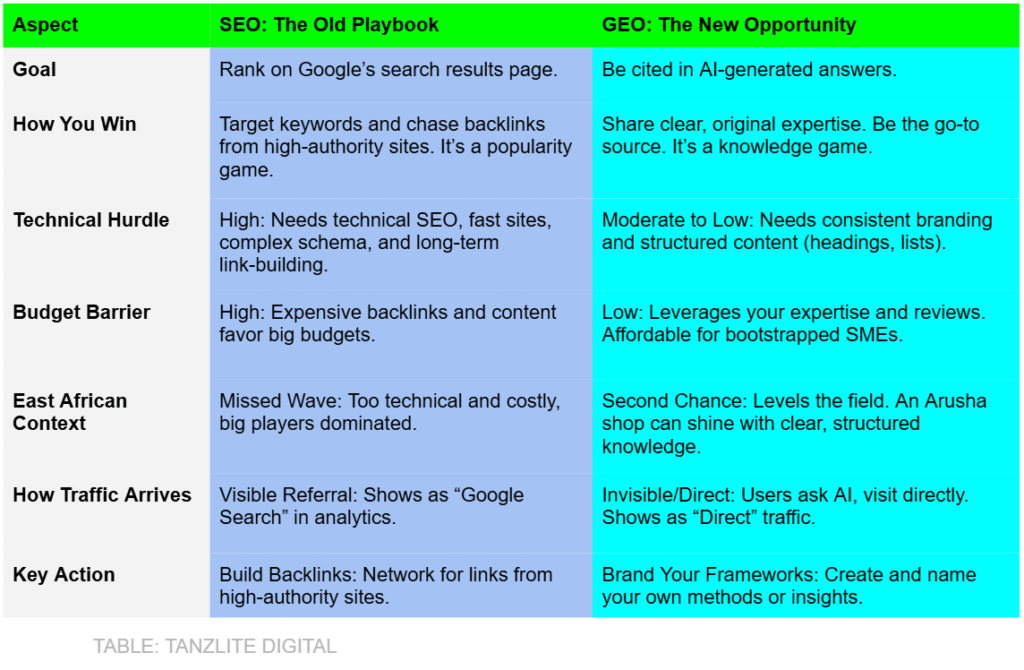
SEO ranks your site on Google; GEO gets you mentioned in AI summaries like ChatGPT or AI Overviews. GEO focuses on branded frameworks and reviews over technical backlinks.
How can I add schema markup to my site for better AI visibility?
Use free tools like Google’s Structured Data Markup Helper for FAQs and reviews. For a Tanzanian shop, mark up product pages with questions like “Do Maasai leather slippers last?” to match voice searches.
Why are reviews so important for GEO?
Reviews add fresh, user-generated content that boosts E-E-A-T. AI favors active businesses.
How do visuals help businesses in AI search?
AI tools are multimodal. Videos like Shorts on “Scaling Agritech in Arusha” get pulled into responses. They appeal to mobile-first users, which is the majority of East Africans.
The Strategic Window: Why Now Matter
Generative AI is still early. Most East African businesses have no idea this exists.
That’s both the danger and the opportunity.
Danger: If you ignore it, bigger players will dominate the AI layer just like they dominated SEO.
Opportunity: If you start now, you can become the default answer in your niche before competitors wake up.
This time, it’s not about expensive backlinks or huge ad budgets. It’s about clarity, consistency, and publishing content that machines and humans can both understand.
If you missed SEO, this is your reset button. Don’t miss GEO.
Thank You for Reading
At Tanzlite Digital, we’ve been helping East African SMEs build direct-to-customer channels through content and strategy. Now, we’re preparing our clients for the GEO era—making sure they don’t vanish from the AI-driven discovery layer.
If you want your business to be among the first names AI recommends in your category, start auditing your digital presence today. Structure your expertise, brand your frameworks, publish original insights, expand your footprint, and leverage reviews.
The machines are already answering. The only question is: will they mention you?
“Africa has too many businesses but too little business,” wrote The Economist recently. And they are right.
From Dar es Salaam’s crowded Kariakoo to Nairobi’s startup hubs, small and medium enterprises (SMEs) power Africa’s economies. Yet most run without a documented marketing strategy, relying on word-of-mouth, ad-hoc promotions, or trial-and-error tactics. Growth becomes luck instead of design.
The truth is this: global playbooks don’t fit neatly here. Power outages, informal networks, limited budgets, and shifting regulations shape reality in ways Silicon Valley templates can’t imagine. That’s why Jumia exited Tanzania, Nakumatt collapsed in Kenya, and why so many promising startups flame out.
But there’s opportunity. Mobile internet penetration is surging, with a projected 71% by 2030 according to GSMA Mobile Economy Sub-Saharan Africa report. WhatsApp is the continent’s largest marketplace, and local SEO is cheaper than a billboard.
The challenge is how to build a marketing strategy that is simple, resilient, and rooted in African realities.
This guide shows you how — step by step.
Why Your SME Needs a Documented Marketing Strategy
Most founders carry their plans in their heads. But memory fades, and busy days crowd out intention. Putting your strategy in writing — even a simple Google Doc — forces clarity.
McKinsey’s research on “strategy champions” shows that companies with documented assumptions make strategic decisions 1.7× faster than their peers. That speed matters. It helps them test what’s working, adjust when the market shifts, and keep execution consistent. Documentation is the discipline that turns vision into momentum.
Instead of a vague dream like “grow sales,” you write:
“Add TZS 50 million in revenue by onboarding 20 new clients through mobile channels.”
This is measurable, trackable, and realistic.
Remember: a strategy is not a to-do list. It’s a roadmap based on beliefs about your market and customers. Tactics are how you execute it. For African SMEs, the core belief should be:
Customers are not faceless data points. They are people in your community.
And when you solve their real pains — like high transport costs, expensive mobile money fees, or unreliable supply chains — loyalty follows.
Step 1: Know Your Audience Inside Out
Everything starts with your customer. In Tanzania or Kenya, where over 70% of consumers are mobile-first, your ideal customer profile must reflect local realities.
Demographics: 25–45 years, urban/semi-urban, bilingual in Kiswahili and English.
Pains: Cash flow pressure from inflation, limited digital literacy despite growing demand.
Hangouts: WhatsApp groups, Instagram feeds, local trade fairs, and church or mosque networks.
Don’t guess. Interview at least 10 customers. Ask simple questions:
“What is your biggest challenge in reaching buyers?”
“How do you usually discover new products or services?”
Avoid over-niching too soon. Africa’s SME pond is vast: retail, agribusiness, services, construction, logistics. What unites buyers is their distrust of ads (60% don’t believe them) and their reliance on word-of-mouth.
Your job is to build trust, speak with honesty, and use Kiswahili when it adds authenticity.
Step 2: Set Goals with Real Numbers
Dreams need numbers. In markets with volatility, 10–20% quarterly growth is already solid.
Bad goal: “Get more clients.”
Better goal: “Onboard 15 new clients by year-end.”
Best goal: “Generate TZS 70 million in revenue, with 8 new clients in Q1–Q2 via content marketing.”
Tie everything to business outcomes:
Lead generation: 90 qualified inquiries per year.
Retention: 70% repeat business.
Referrals: 30% of new business from existing clients.
Use free tools like Google Analytics, or even a simple Excel sheet, to track. If leads dip, pivot quickly. Economic slumps hit hard in Africa, so retention is your buffer.
Step 3: Craft Your Overarching Strategy
Your strategy is the howyou reach goals, not the what. For SMEs here, prioritize intimacy over noise.
Mobile-first, community-led growth beats expensive billboards or TV ads. With social penetration at only ~20% (but rising), focus on trust and networks.
Some proven psychological levers:
Commitment bias: Start with small asks (e.g., free tips on WhatsApp).
Gamification: Offer referral rewards or discounts.
Flow theory: Balance challenges with easy wins (e.g., simplified onboarding).
Avoid copying Western fads. A Super Bowl ad might impress in New York, but it won’t sell airtime in Dodoma. Instead, SMEs can win with sustainability storytelling. Investors increasingly back African SMEs with ESG initiatives.
Step 4: Channels & Tactics That Work in Africa
Map tactics to pains. If digital feels expensive, show budget-friendly tools. If buyers distrust ads, double down on trust-building content.
Here’s a practical channel map for 2025:
Tools to try:
ChatGPT for marketing copy.
Canva for visuals.
For video, you can use the platform’s built-in editing tools such as TikTok or Instagram (always human-edit for cultural fit).
Use the ICE framework (Impact, Confidence, Ease) to prioritize which tactics to test first.
Step 5: Leverage Key Growth Drivers
Three growth levers every SME can tap:
Organic growth: Engage, and share success stories customers want to repost.
Network effects: Create communities where your service improves as more people join.
Rapid experiments: Test 2–3 new ideas every week. Document results.
Retention is king. Smooth onboarding and loyalty loops (e.g., weekly WhatsApp tips) lower churn. In volatile economies, churn kills faster than slow acquisition.
Case in point: AzamTV. Launched in 2015, it scaled to over a million subscribers in Tanzania by 2025, overtaking giants like DStv. Their edge? Local-first content and pricing designed for the market.
Months 4–8 (Optimization): Add referral program, test pricing. Focus on what converts best. Target ARPU of TZS 5 million.
Months 9–12 (Scaling): Build partnerships (chambers, industry bodies), run loyalty programs, launch a free mini-course on digital tools. Target CLTV of TZS 10 million.
Adapt to trends like AI personalization and voice search.
Step 7: The Marketing Mix (4Ps)
A classic still works when localized:
Product: Solve real pains (mobile-first solutions, affordable delivery).
Place: Meet people where they are — WhatsApp, Facebook, Instagram, local fairs.
Promotion: Use content + community first, ads second. Layer in sustainability for investor appeal.
Step 8: Track, Iterate, Stay Resilient
Your KPIs:
Traffic: 5,000 visits/month
Conversion to subscribers: 3%
Leads from subscribers: 40%
Closes from leads: 15%
CAC under TZS 300k
Check funnels monthly. If traffic is strong but leads are weak, improve landing pages. If leads are good but closes are low, adjust sales scripts.
African SMEs need resilience. When recessions hit, shift focus to retention and value content. Strategy is a living document — update it every 6 months.
Case Studies & Local Proof
AzamPesa Before February 2023, AzamPesa’s social channels had thousands of followers but little engagement — posts felt corporate and one-way. Our colleague reframed their content into conversations, repositioned product updates, and aligned copy with audience language. This doubled engagement, comments grew, and discussions turned organic. [Read full case study →]
TWiMMI Tanzania Women in Mining and Mineral Industry (TWiMMI) needed digital visibility to match their advocacy impact. We built a trust-led content strategy that amplified their voice, attracted policymakers, and drew engagement across Africa. Today, their LinkedIn presence commands attention from stakeholders and ministries. [Read full case study →]
These are small examples, but they show the power of documented strategy over scattered tactics.
FAQs
Q: What is a marketing strategy for SMEs? A marketing strategy is your roadmap: who you serve, the main pain you solve, and how you reach your goals with tactics you can afford.
Q: How much should SMEs in Tanzania budget for marketing? Plan 5–10% of annual revenue. For small businesses, this can mean TZS 1–5m/year, spent mostly on content, community, and small paid tests.
Q: Which marketing channels work best in East Africa? Mobile-first channels dominate: WhatsApp for sales, Instagram for discovery, and local SEO for leads. Supplement with SMS and targeted Meta ads.
Q: How do I start writing a strategy today? Write one sentence: We help [X audience] solve [Y pain] by [Z approach]. Then set one measurable goal for the next 90 days.
Ready to Build Your SME Marketing Plan?
Your competitors are waiting for luck. You don’t have to.
Start small: document your strategy, pick 2 channels, and track your numbers. Growth in Africa doesn’t come from copy-pasting Silicon Valley playbooks. It comes from adapting proven principles to our context.
LinkedIn saved my career life. Without it, I would be somewhere; possibly unknown, jobless, and broke. This is my story of how LinkedIn helped me escape Tanzania’s endemic unemployment.
Before joining LinkedIn, I was an endangered candidate. Like the Black Rhinos at Ngorongoro, my chances of surviving the job market were about to go extinct. My degree was no longer a big deal.
Coming from overlooked interiors of rural Tanzania, I had zero connections in corporate TZ. Having attended chronically underfunded and overpopulated schools, I stood little chance in the competitive job market. In short, I suffered a severe Network Gap.
Things changed when I turned to this wonderful invention called the Internet. With the internet, a dim light began to materialize inside my career tunnel.
A laptop and the internet provided me with what Jesus would say “Upon these tools, you shall build your career”. Digital skills are the rocks upon which careers are now built.
So I started learning one digital skill after another, mostly in marketing and advertising.
From content writing to copywriting, graphic design (Canva), web design and development (WordPress), Facebook Ads, and more. I was not going to leave any stone unturned. Specializing or niching would come later. But at that moment, I was determined to be someone who covered many angles in digital marketing.
I built (and still building) a skills arsenal that not only made me competitive in the local job market but also the international started to take notice.
Today, things look more promising about my career trajectory than I was in 2020. And the best part? Since 2020, I’ve never had someone to tell me;
When to be at work
What to wear
How to behave
All thanks to LinkedIn. I am now the most followed Tanzanian marketer on the platform. With over 36,200 followers. What this has brought is I haven’t sent a job application since 2020. I get reached out, not me reaching out.
In the system that works by who knows you, I made myself known through the power of writing online, showcasing my skills, and mastering the art of self-promotion.
If your life is anything like mine, coming from a family with limited resources in a third-world country, then what you want in life will not come to you in a linear fashion. And the unemployment rate in your country will only keep going up. The government will do nothing, as usual.
You have to pick your cross and stumble up the career hill. By which I mean take career matters into your own hands. Learning digital skills is a great place to start. And you have everything to start, like the tool you are using to read this message.
Untapped potential
But despite its potential, LinkedIn is the least used social media platform in Tanzania. It is a bit intimidating to many. I bet this is also the case if you come from a developing country. People haven’t woken up to these online opportunities. They are busy finding jobs in the old, super competitive way.
Your social media pages are not just a mere presence for likes and all; they’re a potential paycheck.
Most Tanzanians who would benefit from the platform (students, graduates, professional workers, founders) either don’t know of its existence, don’t believe in its potential, or think it is simply a place to find a job. LinkedIn is more than that.
As of December 2024, there were 1,512,000 LinkedIn users in Tanzania. This accounted for 2.1% of the country’s population.
If you’re into numbers, this may not seem significant from a country of 60+ million people. But this isn’t just any number. It is an exclusive subset of the Tanzanian population.
Your employer on LinkedIn.
Your client is LinkedIn
Insightful conversations happen on LinkedIn
Knowledgeable people to work with on a project are on LinkedIn
On LinkedIn, you will be standing in front of an audience full of potential.
When I launched my book in late 2023, I used the platform to promote presales and made TZS300,000 in two days. After launch, I reached a total of TZS1.4 million in two weeks. We recently expanded to provide domain and hosting services. So far, we copy-pasted some 13 customers who already trust me. Thanks again for actively creating content on LinkedIn.
Imagine if I was a silent scrolling ghost unknown to anyone. Would I have sold?
Getting started on LinkedIn
If I were to start from ZERO on LinkedIn, this is how I would get to 6000 followers in less than a year:
First, you have to do the necessary job of getting your content in front of people. Make sure you post not less than three times per week. You can go on the offense by showing up daily.
Send at least 300 personalized connection requests in four months. An example of a personalized request that gets accepted; 𝘏𝘦𝘭𝘭𝘰 𝘚𝘩𝘶𝘬𝘶𝘳𝘶! 𝘐 𝘤𝘢𝘮𝘦 𝘢𝘤𝘳𝘰𝘴𝘴 𝘺𝘰𝘶𝘳 𝘱𝘰𝘴𝘵𝘴 𝘪𝘯 𝘮𝘺 𝘧𝘦𝘦𝘥 𝘢 𝘧𝘦𝘸 𝘵𝘪𝘮𝘦𝘴 𝘢𝘯𝘥 𝘐 𝘴𝘪𝘮𝘱𝘭𝘺 𝘭𝘪𝘬𝘦 𝘸𝘩𝘢𝘵 𝘺𝘰𝘶 𝘥𝘰! 𝘞𝘢𝘯𝘵𝘦𝘥 𝘵𝘰 𝘤𝘰𝘯𝘯𝘦𝘤𝘵 𝘢𝘯𝘥 𝘴𝘵𝘢𝘺 𝘪𝘯 𝘵𝘰𝘶𝘤𝘩 🙂
Camping on the comment sections of medium size accounts. What you want is ‘association’. If people associate you with one or two established creators then you join their ranks. I would avoid big accounts because the author may not see your comment. You want someone where the chance of getting a reply is high.
Build a platoon of supporters. You need a team of at least five people to fight and bleed with you on the digital frontline. With these people, you support each other’s journey online.
And that’s it. Growing on social media is actually putting yourself in front of people. Be prepared to face criticism here and there.
Ok, before you go, allow me to insist on this; If the system works by ‘Who Knows You, then you have to make yourself KNOWN. This doesn’t mean going out of your way trying to please people so they include you in their circle. No. Let your talent speak volumes.
The people they know don’t have the skills and talent you have. That’s where you come in, my friend. Let the world know you for what you bring to the table (expertise). Don’t be resentful and say “Ah they give it to themselves”
There’s a way you can get in the game. LinkedIn is a good place to do so. You can go from an unknown nobody to someone whose talent people have seen, heard, and know.
We are all used to our formal education system, where a child doesn’t go astray from what is taught in the school syllabus. A child is only nurtured according to a defined path of education, not having the privilege to have other defined extracurricular activities.
Some NGOs understand that gap/changes in the learning system as per technological changes by providing chances for secondary schools students in developing countries to have extra studies, especially digital skills that will help them adapt and evolve in the digital era.
This is the story of a young girl, among many others, who has been empowered by digital skills to achieve not so much but at her age, a lot in her career and life from an NGO known as Apps and Girls. Highlighting a story of the determination of a young girl in the digital era.
Her name’s Doreen Fatuma Habib, Currently a 3rd year student at the Tanzania Institute of Accountancy (TIA) pursuing a degree in marketing and public relations. Her journey in digital technology goes back to 2019 when she graduated from her O-level studies.
She then joined Apps and Girls, which gives girls in secondary schools opportunities to learn digital technology. Basically, she learned how to code and how to create websites and applications for use. These skills helped her come up with a website.
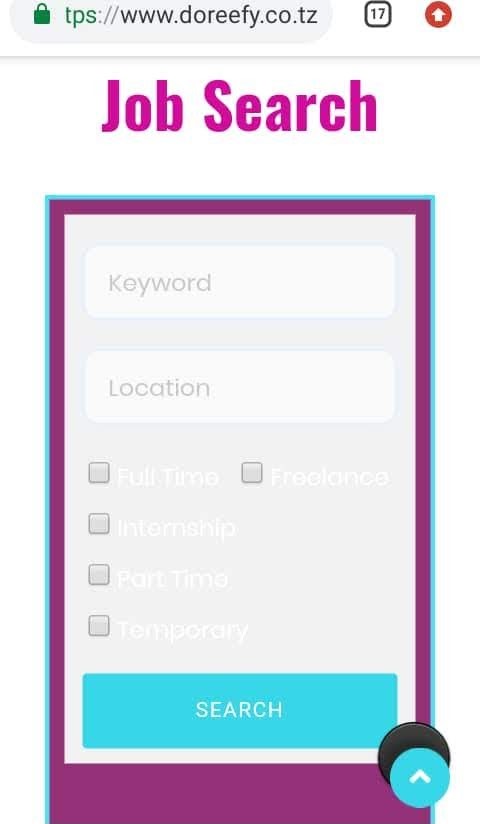
Her first website, Doreefy, where people could see job advertisements, was a product of this training. In 2020, when she joined A-level, she had a chance to teach other students at O-level within the same school how to code, create websites, and develop applications through her knowledge.
It wasn’t all smooth to date; this website was shut down in 2021 because she couldn’t afford to pay the hosts of her website. That didn’t hold her back; she still uses social media platforms such as Facebook and Instagram to keep posting job advertisements through her Doreefy account.
Doreen can’t forget the chances she got at Apps and Girls in 2019. They were involved in the first global challenge that happened to be held in Dubai. And she got an opportunity to represent her country, Tanzania.
The focus was on creating robots that could be used to collect waste in oceans. With other members, they learned and created a competition. Though they didn’t win as a group, the experience and exposure gained from attending it were enough treasures to be kept.
Doreen is currently doing two more businesses online, selling snacks and clothes. She doesn’t own a physical shop or office for this. It’s through her social media pages that she is able to handle her business, and it’s doing well. Visit them; Doreefy’s Instagram account_, Doreefy job platform,and Doreefy_outfit_store.
In the future, she plans to revamp her website and add a shopping section for her clothes and snack business. Isn’t that enough to brighten up your life as a youth? Empower yourself through the digital economy.
Being in the 21st century is a blessing, through digital we are able to witness different journeys of youth at young ages being empowered by digital skills to discover their talents and make an impact in their life and communities.